Parallel Quantum Solutions
since 1997
SUPPORT
by phone: (CST)
M-F 9:30am - 5:00pm
1-877-759-2777 or
1-479-521-5118.
by email:
general/customer service
sales@pqs-chem.com
technical support
tech@pqs-chem.com
PQS ab initio version 4.0 released

Our flagship, primarily ab initio software suite offers highly efficient, fully parallel implementations of all the major calculational methods along with some features unique to PQS. New in version 4.0 are efficient parallel implementations of high-level correlated energies for MP3, MP4, CID, CISD, CEPA-0, CEPA-2, QCISD, QCISD(T), CCD, CCSD and CCSD(T) wavefunctions; enforced geometry optimization (used, among other things, to simulate the results of Atomic Force Microscopy (AFM) experiments); full-accuracy, canonical UMP2 energies and analytical polarizabilities and hyperpolarizabilities for HF and DFT wavefunctions.
The right QuantumCubeTM for my application
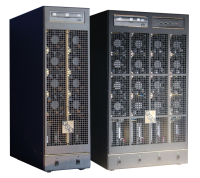
Routine HF & DFT geometry optimization and other jobs that are CPU bound are perfect applications for machines with high number of cores, such as the 128-core QS128-2500C-OA16 QuantumCubeTM. For calculations involving correlated wave functions, such as MP2, CCSD(T), which are I/O bound, a machine such as the 32-core QS32-2670C-XS8 is preferable. This configuration offers more computing resources (memory, disk bandwith) per core.
3D stereo systems

Thanks to recent advances in monitor and projector technologies, we are now able to offer a new 3D stereo enabled line of workstations - the StereoStationTM. The stereo effect is achieved through the use of active shutter glasses operating at 120Hz refresh rate. The glasses are synchronized with the display, either a projector or a monitor, producing two distinct images, one for each eye. The effect is quite breathtaking and is far superior to the earlier technologies of passive polarized and anaglyph (red/blue) glasses.